Choose the agricultural license category
TDA identifies private, commercial, noncommercial and noncommercial political subdivision agricultural applicator routes. Its page states that Texas licensing or certification is required for restricted-use pesticides, state-limited-use pesticides and regulated herbicides. It also identifies a licensing requirement for applying pesticides for hire to plants, trees, shrubs, grass and other horticultural plants, regardless of classification. Describe the service and site before choosing the application.
The private category concerns agricultural production on the property described in Agriculture Code chapter 76. The statute separates that role from commercial and noncommercial activities. An existing private license does not answer every question about a proposed customer service. Include whose property is treated, whether compensation is involved and what crop or site is involved when asking TDA to classify the work.
Use a short preparation note containing the business, applicant, intended products, application method and actual work description. If the work includes aerial application, highlight it at the start. The agricultural exam flyer requires the aerial category to be accompanied by another category, so the full activity matters when choosing examinations.
Private applicant: complete training first
TDA's private testing flyer puts a Private Pesticide Applicator training session first. It directs applicants to county Texas A&M AgriLife Extension offices and identifies an online Texas Private Applicator Training Course. After training, the applicant receives training verification; the flyer identifies PA-404/D-1411 and a completion certificate for the online course. Keep that evidence for the application step.
Obtain the official study materials through the AgriLife route identified by TDA. Keep the training evidence and study manual separate: one demonstrates the training completed, while the other helps you prepare for the examination. If several employees attend the same event, preserve each person's named evidence rather than putting an unlabeled attendance sheet into every application folder.
The statute itself prevents issuance of an original private applicator license before the approved training course. That makes the order of operations important. Do not substitute booking an exam for completing the training, or assume that studying privately satisfies the specified training step.
Submit the application and wait for the TDA account number
The private flyer then instructs applicants to submit PA-400P, the license fee and a copy of the training-verification form. It points to TDA's forms service and Texas Agriculture Portal for the application. After processing, TDA sends a letter containing the account number used for Metro registration and scheduling. Use the number associated with the applicant's actual application.
For commercial and noncommercial applicants, TDA identifies PA-401 for commercial and PA-400N for noncommercial applications. Its flyer likewise puts application and payment before receipt of the account-number letter and exam scheduling. Keep your chosen license type consistent across the form, payment and examination booking.
Review the applicant's name and contact details before submitting. Retain the completed form, training evidence when applicable, payment record and subsequent eligibility letter. These are suggested office controls. If a correction is requested, keep the corrected version beside the original correspondence so that the reason for the change remains understandable.
Register and take the Metro examinations
TDA's October instructions direct eligible applicants to Metro's scheduling service, using the TDA account number. The private route requires the Private Applicator examination. The commercial/noncommercial route requires General Standards plus at least one category examination. For aerial work, the aerial category must accompany an additional category. Match the booking to the route before paying for the tests.
Both flyers state a passing grade of 70 percent or higher, immediate results from the testing center and transmission of exam scores to TDA. They identify a waiting period before a repeat examination. Follow the instructions supplied for your appointment when arranging identification, arrival and any reexamination; preserve the result document with the application file.
TDA issues the license when all licensing criteria are met. Keep a distinction in your own progress sheet between application submitted, account number received, exams passed and credential issued. A passing score is evidence of an exam result; it should not become an unexplained “licensed” status before the department completes the process.
Licence duration and annual renewal
Texas Agriculture Code section 76.113 makes a private applicator license valid for five years. For other applicator licenses, it gives the department authority to establish the licensing period. TDA's current commercial/noncommercial flyer lists annual license fees for its commercial, noncommercial and political-subdivision routes. Keep those annual transactions distinct from the private five-year credential.
Record the actual expiration shown on the license and maintain a separate renewal checklist. A staff member who changes from private production work to a commercial role needs the correct new classification; merely changing an employer name in an old folder does not resolve that question. Use the official agricultural page for the relevant license and category contacts.
Avoid combining a license's validity, an exam-eligibility instruction and a course's credit period into one date. In your working directory, give each document its own label: license expiration, exam correspondence, training completion and renewal submission. This keeps the administrative record readable when a different person handles the next cycle.
Agricultural continuing education: match the credential
TDA's agricultural CEU FAQ requires 15 credits for private applicators, including two in laws and regulations and two in integrated pest management. It also offers the Private Pesticide Applicator Recertification Exam as an alternative route that produces the required credit evidence when passed. Use the official FAQ for the applicable limits on internet or correspondence courses.
Commercial and noncommercial agricultural applicators have a different CEU arrangement, and aerial applicators have specific subject allocations. Read the appropriate paragraph for the actual credential. Do not assume that a private holder's five-year total or a generic pesticide seminar satisfies a commercial aerial requirement. TDA's FAQ provides the distinctions needed for planning.
For each approved course, preserve the completion certificate, date, course number and subject breakdown. Reconcile the documents with the requirement before submitting the renewal. This suggested review can identify a missing laws-and-regulations allocation even when the overall total looks sufficient.
TDA distinguishes agricultural CEU timing before license expiration from structural-pest-control calendar-year timing. Its FAQ also says agricultural completion certificates are retained for 12 months after the most recent renewal. Keep the supporting course documents accessible for that period rather than discarding them when the renewal payment is made.
Common problems to resolve with the right office
| Problem | Start by checking | Keep ready for the inquiry |
|---|---|---|
| No exam-scheduling number | Whether TDA has processed the application | Applicant and application reference |
| Wrong exam appears in preparation notes | Agricultural license type and category | Intended job description and application |
| Training evidence is missing | The private course provider's completion record | Applicant, course and attendance details |
| CEU total seems sufficient but subjects are unclear | Course certificates and subject allocations | Course numbers and completion evidence |
| An employee changes duties | Whether the credential covers the new activity | Existing license and proposed work |
 GrangeBook
Spray records on your phone, ready for any inspection
EPA: product details taken from the registerUnited States: Excel and PDF record sheet to printFull history and corrections
20 treatments free
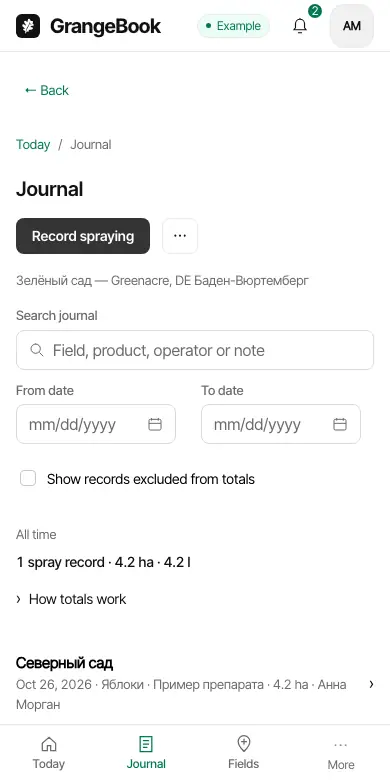
The application and training routes come from TDA's flyers; the CEU review follows its agricultural FAQ. The table is an editorial troubleshooting sequence, not an additional licensing requirement. Use TDA for questions about licensing or categories and Metro's published support route for its exam-scheduling service.
Connect qualification with Texas application records
TDA's agricultural program identifies application recordkeeping as a separate operating responsibility. Use the Texas pesticide application record guide for scope, fields and preservation. Keep the responsible licensee and actual applicator distinguishable in the working record, particularly when office staff prepare documents from field notes.
Use the treatment history to organize completed applications after the licensing steps, and keep the official credential, education evidence and renewal correspondence in the qualification folder. The US license hub routes multi-state questions; the software checklist helps evaluate how your application records survive a staff handover.
Read the October testing flyers as a sequence
TDA's private flyer begins with training, proceeds to application and training evidence, then describes the account-number letter, Metro scheduling, testing and issuance. The commercial/noncommercial flyer begins with study-material preparation and its own application forms before the same account-number and testing stages. Preserve that sequence in the applicant's checklist.
Do not substitute a training invoice for the training verification identified in the private instructions. Keep the completion evidence with the applicant's copy of PA-400P. If the course was online, retain the completion certificate described by TDA. If a paper form was supplied by a trainer, preserve the named document and use the submission instructions associated with it.
A useful application register includes the applicant, license type, form, supporting evidence, submission reference and resulting correspondence. It should explain which stage is finished without turning the register into the authority's decision. The account number enables the next testing step; the issued license confirms the eventual credential.
Prepare a focused Metro scheduling inquiry
The flyers direct applicants to Metro's scheduling service after receiving the TDA account number and supply a support route for testing. For a booking problem, identify the account number, exam requested, attempted transaction and actual error wording. For a question about the license category itself, use TDA's licensing contact instead.
Keep identity evidence, payment records and exam correspondence in the applicant's own folder. Avoid collecting another employee's documents into a shared message merely because several people attend the same training. This is a suggested administrative control: each application and exam result should remain attributable to the correct individual.
Before a repeat examination, review the current instructions and the result showing which examination was unsuccessful. The flyers describe a waiting period for repeat testing. Keep a rescheduled appointment distinguishable from the earlier attempt so office staff can see which result and booking are current.
Understand the agricultural CEU subject allocation
TDA's FAQ identifies laws and regulations and integrated pest management within private-applicator education. For commercial and noncommercial agricultural applicators, it describes the required total and subject allocation, including a separate aerial arrangement. Match the completion certificate's categories to those requirements rather than assuming that every hour is interchangeable.
For aerial applicators, the FAQ identifies laws and regulations, drift minimization and pesticide safety addressing human factors among the aerial-specific subjects. Keep those topics visible in the education ledger. A certificate described only as “pesticide safety” can need clarification before the office assigns it to a particular requirement. Use the actual approved course and certificate details.
TDA also distinguishes approved internet or correspondence courses from internet-based instruction with direct instructor interaction. Keep the delivery method with the course evidence when reconciling the applicable limits. The FAQ's examples include interactive webinars and named conferencing platforms. An electronic attendance form alone does not explain how the instruction was delivered.
Keep agricultural and structural records in separate ledgers
TDA's agricultural CEU FAQ compares agricultural and structural timing and retention of completion certificates. Maintain a ledger for the actual credential rather than merging those periods into a single generic “Texas pesticide training” total. The regulatory program and course approval should remain apparent on the supporting document.
For someone with credentials in both programs, use separate summary sheets linked to the same original attendance evidence when appropriate. Determine which credit applies from the course approval and authority's instructions. This proposed bookkeeping method prevents a calendar-year rule from silently replacing the agricultural expiry-based requirement or vice versa.
The department says it can audit agricultural CEU evidence during an inspection or by requesting certificates. Preserve a readily retrievable index of the documents with the renewal transaction. If a certificate is corrected, retain the provider's explanation so the identity, course and allocation can still be traced.
Assess a change in the business's services
A private agricultural-production activity and a proposed for-hire service need separate classification questions. TDA's program page specifically addresses for-hire horticultural treatment as well as restricted-use, state-limited-use and regulated-herbicide activity. Describe the new work to TDA before assuming the existing credential is sufficient.
Include customers, treatment sites, products and delivery methods in the inquiry. If the new service includes aerial work, identify that method and the accompanying category question described by the examination flyer. Preserve the department's answer with the business plan and the applicant's qualification folder.
For an editorial readiness review, ask a colleague to follow a proposed service from job description to category, examination evidence, issued credential and application-record specification. Resolve any missing link before using a generic staff directory to assign the job. A list of names and license numbers should not conceal an unanswered category question.
Reconstruct one license renewal without oral explanation
Select a person whose renewal was completed and assemble the issued credential, applicable education summary, attendance certificates or recertification-exam evidence, renewal submission and resulting correspondence. Have a replacement administrator explain the relevant period and the source of each credit. Keep a specific correction list for ambiguities.
Common administrative defects include an unexplained surname variation, certificate filed under a provider's marketing name, incomplete subject allocation, missing course identifier or a submission saved without its applicant reference. Those examples are editorial troubleshooting scenarios, not claims about TDA's most frequent enforcement findings. The goal is evidence that another person can interpret after the original preparer is unavailable.
Preserve correspondence during an application correction
Use a dated correction note identifying the applicant, requested amendment and supporting enclosure. Retain the original deficiency message and the response together. A reconciled dossier should distinguish withdrawn drafts, submitted versions, pending examinations and issued credentials without relying on filenames such as “latest” or “final-final.” This is an editorial filing convention rather than an additional TDA form.
Before delegating the next administrative step, identify the owner of the action and the document needed to complete it. That simple handover prevents an eligibility letter from remaining unprocessed in a personal inbox while a scheduling spreadsheet suggests the applicant is ready.