Identify the production setting
The WPS definition of agricultural establishment includes farms, forest operations, and nurseries engaged in outdoor or enclosed-space production of agricultural plants. Agricultural plants include plants produced for commercial purposes, including sale or trade, research or experiments, or use at another location. The definition includes seedlings and transplants as well as flowering and foliage plants and trees.
Enclosed-space production means agricultural plant production indoors or in a structure or space covered wholly or partly by a nonporous covering and large enough for a person to enter. Use that definition when describing the production setting. Preserve whether the treatment was in an identified house, compartment, propagation area, or outdoor nursery block so the workplace information can point to the actual area.
EPA's WPS overview expressly includes greenhouses and nurseries. The family-farm guide treats the separate owner/immediate-family question. Here, focus on the information workflow for an operation with applicable employer responsibilities, then use the state guide for local application records.
 GrangeBook
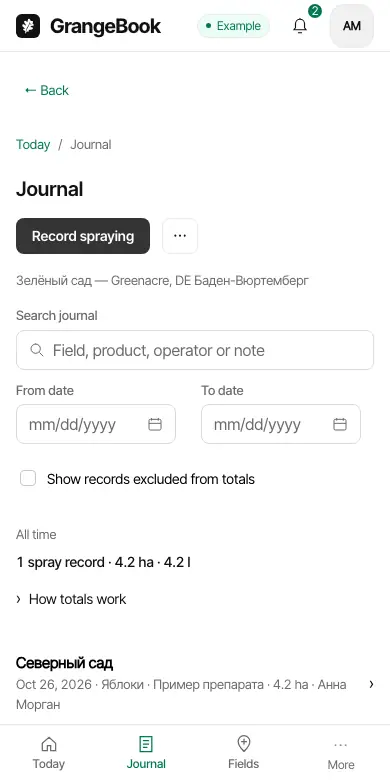
Spray records on your phone, ready for any inspection
EPA: product details taken from the registerUnited States: Excel and PDF record sheet to printFull history and corrections
20 treatments free
Replace legacy USDA instructions with state requirements
The 2025 final rule removes Part 110 in full. Its old spot-treatment exception and its exclusions for greenhouses and nurseries are not current USDA recording instructions. An older worksheet can still contain useful headings, but it cannot establish a present federal duty or recording shortcut.
Choose the state record category before assigning fields or a completion deadline. Keep the actual product, treatment date, house or block, measured amount and treated extent connected in your working note, and compare that information with the applicable state's guide. For the separate WPS output, retain every item in the field list below. The removed USDA 14-day deadline does not set the WPS posting timetable.
For a nursery register, keep the location reference and treated size separate. A bench or block name explains where the treatment occurred; the recorded size explains the treatment extent. Preserve the appropriate unit used in the source note and do not force a different production situation into an unexplained acres-only column.
WPS application and hazard contents
| Information | What belongs with the treatment |
|---|---|
| Hazard document | Safety data sheet for each pesticide product |
| Product identity | Name, EPA registration number, and active ingredients |
| Treatment location | Crop/site plus location and description of treated area |
| Timing | Dates and times application started and ended |
| Restricted entry | Duration of the applicable label-specified REI |
These are the contents of 40 CFR 170.311(b)(1). Link the SDS and product identity to the application reference so the worker-information file does not depend on recognizing an informal product nickname.
A state application worksheet containing quantity and site information can contribute data, but it does not by itself supply an SDS or all the listed worker-information fields. Prepare the outputs from a common treatment reference while retaining the details required for each. A worker-facing display and an agency or certification export have different audiences.
Locate treated areas for employees and outside handlers
The WPS application-information display is placed where workers and handlers are likely to pass or congregate, where it can be readily seen and read. Access is allowed during normal working hours and the displayed information remains legible. Identify the person responsible for preparing, updating, and replacing the display copy.
Section 170.309(k) also addresses information supplied to a commercial handler employer about specific treated-area locations, descriptions, and entry restrictions where an REI is in effect and the handler may enter or walk within one-quarter mile. Preserve that location relationship when preparing instructions for an outside application or service crew.
For a greenhouse complex, prepare a plain-language key connecting the recorded house or compartment names to the signs and descriptions employees use. For outdoor nursery blocks, preserve the correspondence between the map and field notes. Have an unfamiliar colleague locate the treatment from the key before relying on abbreviated names in routine records.
Distinguish worker activities from handler activities
The WPS handler definition includes mixing, loading, applying, and certain equipment cleaning, adjustment, handling, or repair involving possible residues. It also identifies particular enclosed-space entry tasks involving ventilation equipment, air monitoring, or fumigation coverings before the specified exposure or ventilation criteria are reached. Use the actual task description when organizing the workplace file.
Keep the application record, equipment-service note, and personnel training reference connected without labeling every task simply greenhouse work. Identify who performed the activity and which treatment or equipment it concerned. This is an editorial way to preserve the task distinctions in the definition; it does not authorize early entry or replace the relevant product labeling.
Section 170.309(g) addresses equipment cleaning, repair, and adjustment, including information supplied before a person not directly employed by the establishment works on used pesticide equipment. Keep that equipment's application history and the responsible contact retrievable when arranging maintenance.
Display timing and archive timing are separate
Application and hazard information is displayed no later than 24 hours after application ends. The display continues until at least 30 days after the last applicable REI ends or workers/handlers are no longer present, whichever is earlier. The employer retains the information on the establishment for two years after the applicable REI expires.
The employer-duty provision also prevents worker entry until the required application/hazard information is displayed and the other listed REI and warning-sign conditions are met, subject to the specified early-entry provision. A record workflow should therefore identify how information becomes available before workers return, alongside the rule's outer display timing.
Keep actual application completion, REI duration, and REI-expiration reference distinct in the register. Preserve the source of the interval from the product information used for that treatment. Do not use an illustrative interval from a blank template as a live value or treat an old record's timing as the default for a new product.
Prepare for information requests
A covered worker or handler may request retained application/hazard information, orally or in writing, with the employer providing access or a copy within 15 days. Treating medical personnel have a separate prompt-access provision. Preserve a retrieval index that links product, treated location, application period, and SDS.
Section 170.309(f) identifies the SDS, product/EPA/active-ingredient information, and application and exposure circumstances among information provided to treating personnel in its emergency-assistance situation. Identify a backup contact who can retrieve these documents without the usual grower or applicator being present.
A location-based record review
Choose a completed greenhouse treatment and a nursery-block treatment from your own records. Trace each from the location key to product identity, application times, treated size, SDS, and REI information. Then locate the private RUP record where applicable and explain which unit describes product amount and which describes treatment extent.
Ask a reviewer to repeat the exercise using the displayed or saved copy rather than the working draft. Record specific corrections to unclear compartment names, missing attachment references, or carried-forward times. Preserve the supporting note and explanation of the change. This proposed review makes the different record layers usable without inventing a single national form for every production arrangement.