2024 rule update: the AEZ final rule, read October 28, 2026, took effect December 3, 2024. Its amendments address application exclusion zones, handler training and related family exemptions; they leave §170.311’s application-information records and display provisions unchanged. Sections B and D remain the records/display comparison used here; use EPA’s current AEZ guidance for the checklist’s application-zone questions.
Prepare pesticide inspection records by connecting the application register to product information, locations, SDS files, worker-information displays and the people responsible. EPA's WPS inspection manual describes records review, interviews, training and respirator-safety records. USDA Part 110 was removed effective July 11, 2025, so its former access provisions are not a current inspection basis. Use the applicable state and WPS rules for present access duties.
Start with a document index
Create an index identifying the application period, record category, storage location, responsible contact and attachment references. Separate state application records from WPS application/hazard information and certification documents. Use the country and state guides to determine the applicable content and timing before checking whether the documents are present.
A practical inspection packet can have these sections:
- Application register with complete product, location, date, quantity, and responsible-person references.
- Field, block, house, or other location directory used for the period.
- Product-label and SDS index linked to relevant treatments.
- WPS application/hazard display and retained information where applicable.
- Personnel and training evidence relevant to the work performed.
- Contractor copies, submission references, and correction correspondence.
This is an editorial packet structure. EPA's manual separately identifies application/hazard information, pesticide-safety training, respirator records, and interviews as inspection topics; the cited record rules establish the specific legal contents.
Use current state and WPS access provisions
The final rule in Federal Register 2025-08220 removed 7 CFR Part 110 in full, effective July 11, 2025. The former credentialed-access provision in section 110.3(f) and comparable-state-record provision in paragraph (h) are historical. Prepare for inspection using current WPS duties and the access rule for the state and activity involved.
Identify the person who handles the request and a backup who can locate the same files. Preserve the request reference, the period covered, and which documents were provided. If one spreadsheet contains several categories of data, prepare a view that keeps the relevant application information together with its field meanings and units.
For WPS records, section 170.309(m) provides access for EPA employees and duly authorized federal, state or tribal pesticide-enforcement representatives. Washington's statute separately gives its department inspection access and specifies copy-response duties. Keep the actual authority, requested period and documents supplied together in the request index.
WPS application and hazard information
40 CFR 170.311 includes the SDS, product name/EPA number/active ingredients, crop or site and treated-area description, application start/end dates and times, and label REI. Retention on the establishment runs for two years after the applicable REI expires. Preserve the SDS link so the reviewer can identify the document associated with the product.
Review the displayed and retained copies separately. The display location must be somewhere workers or handlers pass or gather and can readily see and read the information. Access during normal working hours and legibility are explicit requirements. A complete office archive does not describe whether the worker-information display is readable and accessible.
Section 170.309(m) requires records or other information under the part to be available for inspection and copying on request by EPA or duly authorized federal, state, or tribal pesticide-enforcement representatives. Keep the index usable by someone other than the usual record preparer.
Understand how the inspection manual uses evidence
EPA's 2018 WPS manual describes application-information review using a combination of record review, interviews, and visual inspection of products in storage. Its checklist suggests identifying WPS products used, or with an REI in effect, in the past 30 days, with a minimum of three products if possible to facilitate inspection. That is a manual sampling approach, rather than a new legal requirement for a farm to use three pesticides.
The manual also states that it is not a regulation and does not add, eliminate, or change existing requirements. Use the current cited rule for the precise display and retention timings. Preserve the manual's title and date when using its checklist internally so staff can distinguish guidance from the controlling provision.
 GrangeBook
Spray records on your phone, ready for any inspection
EPA: product details taken from the registerUnited States: Excel and PDF record sheet to printFull history and corrections
20 treatments free
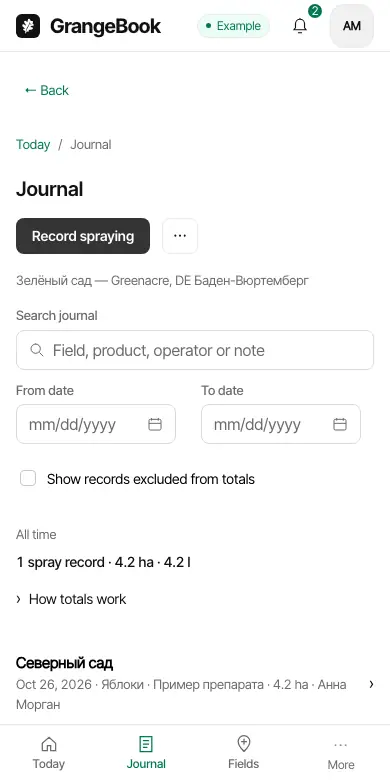
For a preparation exercise, choose real application records from your file and trace them to stored product identity and the SDS. Compare dates and locations across those documents. Record a discrepancy precisely instead of assuming that a checked box on an internal checklist proves the underlying record is complete.
Training records need identifiable people and events
The manual's worker-training checklist identifies worker name, signature, training date, EPA-approved materials, trainer name and qualifications, and agricultural employer among the reviewed information. It separately addresses handler training and respirator-safety records. Organize the relevant evidence by person and training event, with a readable attachment reference.
Keep an applicator license separate from a training attendance record and from a respirator evaluation or fit-test reference. Label the purpose of each document rather than putting every personnel attachment in an undifferentiated folder. When someone appears in the application record under initials, preserve the key connecting that abbreviation to the named person.
During the review, ask the supervisor to locate the evidence for the people associated with a selected application. Preserve the source of a correction to a name, date, or document reference. These are organization suggestions for the manual's review topics, without adding a new training period or making assumptions about an individual's qualification.
Contractor records and treated-area information
Section 170.309(k) addresses treated-area and entry-restriction information supplied to a commercial handler employer in the stated circumstances. Keep the incoming contractor application copy, the farm location key, and relevant treated-area instructions connected. Do not rely on the customer invoice as the only evidence of what occurred at the site.
For a field or orchard review, trace the contractor's place name to the farm's map and the actual treatment area. Compare the product identity, application timing, and applying-person references. If the contractor and farm use different block names, preserve a correspondence key rather than silently changing the original returned report.
State inspection access can add practical deadlines
Washington RCW 17.21.100 includes record inspection as part of on-site agricultural-land inspections under the chapter. It addresses whether records are transferable to the department's form and readily available. The statute provides immediate copies for treating health care personnel when needed for determining treatment and a 72-hour period for other requests under its stated subsection.
Use the state guide for local access and format procedures. A record system spanning several states should preserve each application's location and record category so a retrieval request is routed to the appropriate instructions. Keep the statutory period in the retrieval guide alongside the person responsible for responding.
Resolve discrepancies with source documents
Use a correction log naming the application, disputed field, original wording, supporting document, and resolved value. Preserve the original field note and relevant correspondence. Distinguish a missing document from an unclear measurement and from a mismatch between two existing records. Assign the question to the person able to supply the underlying information.
Avoid filling a gap from an unrelated treatment just because the product or crop looks similar. For an unclear location, resolve the map reference. For an amount, identify the magnitude and unit. For timing, distinguish application start/end from transcription or dispatch. Keep the explanation with the corrected entry so a later reader can follow the review.
Perform a retrieval rehearsal
Give a colleague a location and period and ask them to find the application, product identity, SDS where applicable, actual timing, responsible people, and supporting contractor evidence. Then repeat the task using a product name instead of a location. Open the saved copies from the archive that would actually be used for a request.
Record which part of the retrieval required oral explanation and improve that part of the index. Preserve the corrected key, attachment reference, or column definition with the relevant season. This proposed rehearsal prepares a concrete, interpretable file for the access and review processes described above; it does not predict inspection frequency or an enforcement outcome.
Calculation notes and a working record
Use the tank mix calculator to prepare quantity calculations and the spray record sheet guide to choose a printable worksheet or official form resource. Keep the preparation note attached to the treatment it describes.
For this related task, see the two-year recordkeeping statement and legacy worksheet corrections.
Common gaps to resolve before the visit
Check that an SDS opens from the archive, that the display can be read where workers pass, and that a backup contact can retrieve the application by location and date. A complete spreadsheet with a broken SDS reference still leaves the information packet incomplete. Use the actual source documents to resolve gaps; preserve the original entry and a dated correction note.