Choose a worksheet by the applicator category, place of use and intended recipient. Keep that choice with the blank master before distributing copies to a farm crew or contract sprayer. The following guide helps you select a printable form, organize the information and assemble a spray log book without treating every sheet as interchangeable.
Printable spray record sheet template: choose a download
| Download or official directory | What to use it for | Where to go next |
|---|---|---|
| GrangeBook blank PDF | Printable working worksheet | Add application information and supporting documents |
| GrangeBook Excel workbook | Spreadsheet working copy | Review its state-specific source map and units |
| NC State recordkeeping forms | Extension examples by applicator category | Check legacy USDA instructions against the 2025 rescission |
| WSDA recordkeeping directory | Washington versions by job structure | Use the Washington guide for state duties |
| Minnesota application record templates | State templates by category | Match the activity to the current state category |
The local downloads are GrangeBook working worksheets. The other resources in the table are published by NC State Extension and the named state agencies. Preserve the publisher and purpose when saving a file. A worksheet's appearance or filename does not establish which requirements apply, particularly where old instructions refer to the removed USDA regulation.
Add state fields before using the generic worksheet
The PDF and workbook are working layouts. They do not reproduce every field in the following official forms. Keep an attachment or use the state form when the generic heading cannot express the required detail.
| State form | Details to preserve beyond the generic worksheet headings |
|---|---|
| California 017C / 183 / 025 | Site Identification No., County Number, Section/Township/Range, Base and Meridian, Pre-Plant and the covered schoolsite method code |
| California 025 | Days Preharvest (optional on the form) |
| Washington Version 1 | Chemigation depth, apparatus license plate, WSDA permit selection/number and the field-map panel |
| Texas Q527 | Regulated-county selection, regulated-herbicide permit number, FAA N number and the form’s three training-document choices |
| North Dakota SFN 62506 | Pesticide registrant and applicator signature |
| Florida suggested record | Property owner authorizing application |
A general Equipment ID, Permit reference, Client / owner or User qualification evidence column needs explicit mapping to the destination field. Preserve signatures, maps and original supporting documents as attachments; a typed name or a generic equipment nickname does not supply those documents. For Washington, the field-map requirement applies to an application to one acre or more of agricultural land; the department’s acceptance of an alternative format is discretionary.
Select fields after the USDA rule change
Federal Register 2025-08220 removed 7 CFR Part 110 effective July 11, 2025. The old federal private-applicator fields, 14-day recording deadline and two-year retention period should not be presented as current USDA requirements. Start with the state lead agency, applicator category and product classification, then add the separate worker-information output where WPS applies.
USDA's legacy recordkeeping guidance distinguishes the EPA registration number from the establishment number and total concentrated-product quantity from active-ingredient percentage. Those terminology distinctions do not restore the removed Part 110 duties. Keep separate headings for identity and quantity, then write units beside the amounts.
As a practical record-book method, keep a directory of applicators and credentials with clear links to the entries they cover. Whether a shared heading contains all required information depends on the applicable state rule. Check the completed page or detached export rather than assuming that an old federal form instruction authorizes every layout.
NC State forms: separate the private and commercial routes
NC State Extension's directory lists a private-applicator manual, reference sheets, a WPS training-record form and a one-page on-farm form addressing RUP and WPS recording. Its commercial section separately offers PDF and Excel application forms. The directory also separates fumigation and non-certified-applicator training resources. Choose the resource by its stated purpose before printing or copying its headings.
The one-page private-applicator publication refers to the former USDA regulation alongside WPS. Treat it as a legacy combined worksheet. Use the rescission rule for USDA's current regulatory status and 40 CFR 170.311 for current WPS contents, timing and access.
For a farm using a contractor, prepare a receiving folder for the contractor's completed records. For an applicator preparing customer copies, keep the customer's name and treated-property reference together in your dispatch notes. Use the relevant state guide to determine the required information and delivery procedure; the private and commercial sections of a directory are starting points for that routing decision.
Washington versions: match the structure of the job
WSDA distinguishes a single application at one location by one applicator, multiple applications at one location by one applicator, and multiple applications involving one or more applicators. It also lists commercial landscape and pest-control-operator versions. Select the layout that makes individual treatments and people understandable rather than compressing everything into a generic daily total.
When requested, WAC 16-228-1320(5) calls for an appropriate Pesticide Application Record. The department may accept another physical or electronic form if it contains all required information and its form and format are acceptable to the department. Preserve a mapping from a custom sheet to the official headings. For the complete local workflow, use the Washington pesticide application record guide.
During a mapping exercise, place the field note, custom worksheet and destination form beside each other. Trace each location, date, person and quantity into its destination. Give an attachment the same job reference as the main entry. A marginal addition should identify the row or treatment it completes; a reader should not have to guess which application owns it.
Minnesota templates: category and revision matter
Minnesota's directory supplies category-specific application templates, including field crop pest management, indoor greenhouse and plantscape work, outdoor turf and ornamentals, seed treatment, and other activities. The agency says applicators can use its downloads or create their own records capturing the same information. The directory says starred forms were updated in August 2024, but the linked Category C field-crop PDF carries the footer date 8/1/15. Save the actual PDF revision with the blank master; the directory date is not the Category C footer date.
When saving a template, include the category and revision in the blank-master filename. Keep the original download beside the working copy, then describe any columns you add for your operation. If your business performs different kinds of work, store the relevant templates separately and choose the appropriate category at job preparation.
For a greenhouse, vineyard or orchard, write out the production location in a way the next reader can follow. Preserve the naming key for structures, blocks, rows or sections that your operation actually uses. This is a proposed organization method; the agency's category-specific template remains the reference for its information requirements.
Add the worker-information documents where applicable
40 CFR 170.311 lists application information including product name, EPA number, active ingredients, restricted-entry interval, crop or site, treated-area description, and application start and end dates and times. It also identifies a safety data sheet for each product among the hazard information. Keep these documents connected to the application they describe.
A useful attachment index names the product, document type, document filename and associated treatment reference. Use separate references for the product label and safety data sheet. EPA explains that pesticide labeling sets the legally enforceable directions and conditions for use; preserve that document's identity when recording the source of an interval or other instruction.
For a workplace-information review, ask the responsible person to retrieve the application entry and its matching product documents. Read the treatment location and times aloud, then confirm that the document references concern the same product. For more detail on production settings, use the greenhouse and nursery records guide.
Complete a spray record template from the actual job
Treat the following as an editorial completion routine. It organizes a record review without replacing the field list for your jurisdiction or certification scheme. Gather the actual application notes, the selected blank master, location references and product documents before transcribing an entry.
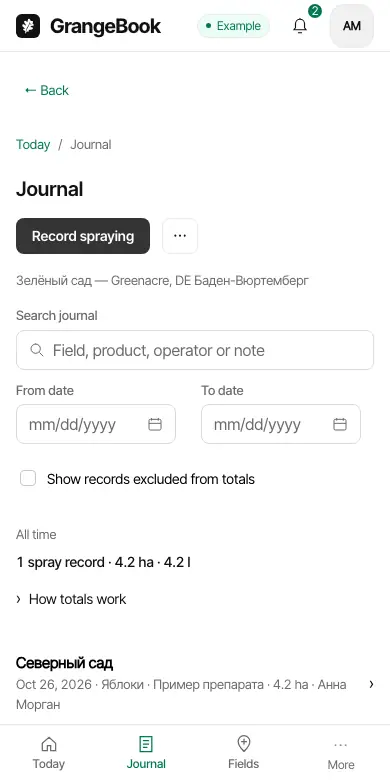
 GrangeBook
Spray records on your phone, ready for any inspection
EPA: product details taken from the registerUnited States: Excel and PDF record sheet to printFull history and corrections
20 treatments free
- Copy the application identity and the date from the source note.
- Identify the treated location, crop or site and actual extent.
- Preserve each product's exact identity and corresponding registration number.
- Label total formulated-product quantity, application rate and spray volume as separate quantities.
- Identify the person associated with the entry and connect the relevant credential reference.
- Attach workplace information or other supporting documents relevant to that record's purpose.
- Review any corrected entry against the original note and preserve the explanation.
Use a unit dictionary beside the spreadsheet. Define each heading in ordinary language: total product means the quantity for that product and treatment; rate has a stated denominator; treated extent has a physical unit; spray liquid has a volume unit. Put these definitions in the working instructions so an office colleague and a field applicator use the headings consistently.
If an entry says only ounces, ask whether the original measurement was fluid volume or mass. If a field says area but contains a tank capacity, correct the quantity heading before copying the figure elsewhere. For preparation arithmetic, use the tank mix calculator. Keep its planned quantities identifiable when completing the record from actual work.
Assemble a spray log book that survives handover
Create a cover index with the season, record owner, location-key reference, blank-template version and folder location. Assign application references consistently within your own filing system. Put a cross-reference on every continuation sheet so a detached page can be reunited with its entry. These are suggested filing choices rather than additional government-prescribed fields.
Keep the applicator identity reference understandable independently of a familiar signature or initials. When a shared header is used as a working method, make its relationship to the entries visible and compare the completed output with the applicable state rule. Keep prior credentials with historical records so a personnel change does not silently rewrite the old file.
Separate blank masters, completed entries, supporting documents and sent copies. Preserve the copy actually received from a contractor before making an internal transcription. If a sheet is scanned, save the complete page and make the file reference readable in the index. Record which treatment an attached map or handwritten continuation explains.
Practice retrieval with a colleague who did not prepare the entry. Ask them to locate a record by date, by treated location and by product. Have them explain the unit attached to every quantity. Then ask them to retrieve the relevant attachment without relying on the original preparer's memory. Document an unclear abbreviation, missing continuation or mismatched product reference as a specific correction task.
PDF, Excel and paper: preserve the same meaning
Use PDF for a printable copy and the workbook for a spreadsheet working record. When transcribing between them, compare the meaning of the headings as well as the visible numbers. Avoid placing a rate into a total-quantity column because the boxes occupy similar positions. Keep abbreviations readable outside the software used to prepare the entry.
Before printing a populated worksheet, inspect the intended rows, column headings, units and continuation references. Keep application rows associated with their location and product identities. Review a saved output independently so a colleague opening the file later has the same information that the preparer saw. Screenshots and visual layout checks belong to your own review process.
After a software change, retrieve a historical entry and its attachments from the saved archive. Confirm that the older location key still explains the place of treatment. Preserve original dates and identifiers instead of relabeling every imported entry with the migration date. For evaluating exports and staff access, use the pesticide recordkeeping software guide.
Filled example: quantity and attachment fields
Invented training example only. This partial row illustrates column meanings; it is not a complete application record, a product recommendation or a legal compliance example. All names and quantities below are fictional.
| Field | Example entry |
|---|---|
| Record type | EXAMPLE |
| Application / tank ID | TRAINING-01 |
| Field / block ID | Example Block A |
| Total product quantity | 2 |
| Product quantity unit | gal |
| Treated size / quantity | 10 |
| Treated size / quantity unit | acre |
| SDS file / attachment reference | TRAINING-01-SDS |
The example’s product quantity divided by its treated area is 0.2 gal/acre. This is arithmetic using invented quantities, not a dose to apply. A real entry also needs the actual labeled product identity, EPA registration number, dates, people and all applicable state fields. Keep the training row outside completed operational records.
Fictional filing example: connect a detached continuation
This example is an invented document-organization exercise. It contains no actual application, pesticide, dose or compliance determination. Imagine that an orchard office receives a handwritten front sheet marked “Block North” and a separate continuation marked “Job A.” A spreadsheet entry uses “North Orchard,” while a scanned attachment has only a date in its filename.
Begin by writing a reconciliation note that identifies the documents without guessing that they describe the same work. Ask the preparer which location key explains each name, which treatment owns the continuation, and what the scan adds. Preserve the original wording while the relationship is being resolved. Do not manufacture an application date or product identity to fill the spreadsheet.
After the preparer supplies the missing relationship, give the completed packet a consistent internal reference. Add the reference to the index, transcription and continuation, and retain the explanation with the original sheets. Describe which wording is a location alias and which wording is a job identifier. This is an editorial filing method for making a packet understandable.
Now ask a colleague unfamiliar with the orchard to retrieve the packet from the index. Have them explain the document sequence, distinguish the handwritten evidence from the later transcription, and identify where the preparer's clarification is stored. If they cannot locate the continuation or explain a renamed block, revise the index rather than assuming that familiarity with the property will solve the problem.
For a contractor packet, add a receiving note naming the source of the documents and the copy used for transcription. Keep a sent-copy reference separately if your office subsequently supplies a record to someone else. Distinguish receipt, transcription, review and delivery as separate administrative actions so an archive search does not confuse them with the application itself.
Prepare a retrieval note for the archive custodian
Write a retrieval note naming the archive custodian, alternate contact, folder hierarchy and naming convention. Include an example of how an internal job reference connects to a continuation, a map and an incoming contractor document. Use an invented identifier only in a clearly labeled training specimen; keep that specimen outside completed operational entries.
Describe how to distinguish an original, a transcription, an amended copy and a superseded blank master. Identify who can explain an unresolved abbreviation or restore a misplaced attachment. This proposed administrative note helps a successor navigate the archive without reconstructing the filing convention from personal recollections.
Keep a blank-master register
Maintain a small register describing the publisher, original filename, download location, revision shown on the document and local working-copy name. Record the purpose for which your operation selected that version. Save the source resource alongside the blank master so a replacement office manager can understand the selection.
When introducing an amended layout, review the headings against the earlier master. Identify renamed quantities, moved credential fields, added attachments and changed continuation references. Preserve the older completed records with the instructions that explain their abbreviations. Avoid silently imposing a new column meaning on historical entries.
For a paper-to-spreadsheet transfer, nominate a preparer and reviewer in your own office procedure. Resolve illegible handwriting with the original author and keep the clarification. An empty cell, an explicit correction and a statement that a field does not apply communicate different things; preserve the explanation rather than substituting an unexplained symbol. These are suggested controls for transcription and retrieval, not additional statutory fields.
Use a completion review before filing
Pick one actual treatment and assemble its source note, completed row, product references, location key and attachments. Ask a reviewer to describe what happened using that packet alone. Resolve contradictions in product identity, extent or quantity before the same wording is repeated across additional records. Retain the explanation of a correction with the treatment.
Use the inspection checklist to review the completed packet and the retention guide to organize storage. The US hub routes to the state and operation-specific requirements. Keep the selected legal or scheme reference beside your working instructions so the blank sheet, completed record and eventual recipient remain connected.
Before you complete a pesticide application record form
Use the applicator license hub to resolve the person and jurisdiction, then choose the state record specification. For North Dakota farm records, use that state’s current private or commercial/public route. For Florida records, preserve the separate R and W purposes explained by the FDACS form. The worksheet is the place where the applicable information is collected; choosing it does not select the law for the operation.
Keep planning calculations separate from completed application data. The boom calibration guide explains actual equipment output, while the tank mix calculator performs quantity arithmetic. Write the actual product and amount into the completed record rather than silently treating a preparation calculation as proof of what was applied.
For this related task, see custom spraying quote worksheet.